Showing posts with label Data. Show all posts

February 10, 2016

Welcome

Sometimes a cause is too important to abandon, even though one's efforts in advancing it over the years wax and wane as life's demands and transitions absorb more time and attention. So it is for me with the problem of vehicle-into-building crashes. The intensity of my focus has brightened and dimmed, repeatedly, since I was hit in 2008. The flame of my concern nonetheless remains.

I commend Storefront Safety Council co-founder and safety expert Rob Reiter for having continued the effort, unabated, to not only shine a spotlight on the problem but also to continually add to his data on the frequency of these crashes.

Likewise, a big thanks goes to the news media for it's coverage of the issue. It's been a privilege to serve as a resource for reporters and producers.

Kudos also to Kimberly Reiter for doing a great job building and maintaining the StorefrontSafety.org website. It is now a much more robust online home for crash examples and safety tips than my own site here, particularly as many of the links to newspaper and TV stories on specific crashes featured in my older posts have gone dormant. (Some media outlets keep their older content online for years, while others delete it more quickly.)

As I've noted before, many lives are profoundly changed month after month because of the flaws in our built environment that leave people exposed to errant drivers and out-of-control vehicles. The need to implement prevention and protection strategies continues.

If you are landing here for the first time...welcome. I hope my archived material will prove useful for you. And if you're visiting simply to see if a light still shines in the window...thanks as always for your continued interest.

Either way, by all means go visit Rob's sites. And you can still reach me at: mark [at] wrightscontent.com.

—Mark

(Image credit: The original photo came from a candle company via Amazon.com, but has been significantly altered for use on this site.)

February 24, 2014

Data Gives Insights into Crash Problem

Part I: When risk control pro David Natalizia surveyed colleagues via his blog to assess their perceptions about vehicle-into-building crashes, he got responses from 20 readers — and made some interesting discoveries:
  • First off, 90 percent of the respondents had a pretty high level of awareness that these accidents happen frequently — and 75 percent recognized that the magnitude of the problem would not be picked up by NHTSA data.
  • They held a strong impression about who’s typically not at the wheel during these crashes, with 85 percent indicating that most such crashes do not involve teen drivers.
  • Respondents showed less consensus about the statement, ‘Positioning parking spaces perpendicular to a building may increase risks,’ with 65 percent agreeing, 20 percent neutral, and 15 percent disagreeing.
  • Awareness about the ineffectiveness of wheel stops and curbs as crash barriers appeared to be high, with only 10 percent agreeing with the statement that ‘Wheel stops and curbs effectively prevent vehicles from crashing forward into buildings.’
  • There was significant disagreement around the survey question that stated, ‘No standard practices exist for controlling this hazard,’ with 70 percent disagreeing, 20 percent agreeing, and 10 percent neutral.
I’ll be asking David to weigh in with his interpretation of those findings, but for now let me simply say ‘Thanks!’ to him here for posting the survey on his blog and being willing to engage his readers on this issue. Risk control professionals have a huge role to play in moving the vehicle-into-building crash conversation forward with other key audiences.

Part II: Another set of interesting numbers came out this morning in the form of charts from Rob Reiter, showing several findings based on his stats from 2013. A couple of them surprised me, but for now I’ll leave you with Rob’s work:

Source: Rob Reiter


Source: Rob Reiter


Source: Rob Reiter

If you prefer pie charts, you'll find 'em here.


July 23, 2013

Texas Transportation Institute Spotlights Need for Storefront Barrier Standards

Infographic: Texas Transportation Institute
The Texas A&M Transportation Institute (TTI) added its voice today to the call for prevention of storefront crashes in its article, 'Parking Is a Full-Time Job', published online.

TTI Assistant Agency Director Dean Alberson — who led the team that developed the ASTM testing standard used by the U.S. State Department to help protect embassies and other facilities from vehicle crashes — noted that while storefront crashes are preventable, businesses should install vehicle barriers that meet an effectiveness standard. Otherwise, the barrier might not work as a business intended.

“We have the expertise and facilities needed to codify the new standard for storefront crashes,” Alberson said in the TTI article. “We’ll be conducting tests for manufacturers who want to prove their products meet the new ASTM standard we’re currently developing.”

TTI completed a longer paper on the issue this week — 'Data Analysis and Prevention of Vehicle-Into-Building Crashes: An examination into the frequency of vehicle-into-building crashes and a solution to protect people from such accidents' — co-authored by Alberson, TTI Graduate Assistant Researcher Felicia J. Desorcie, E.I.T., and Storefront Safety Council co-founder & Blockaides Inc. consultant Rob Reiter.

I'll post a link to that larger paper when it becomes available online.

July 15, 2013

Case Study: Starbucks


When Storefront Safety Council co-founder Rob Reiter did a scan of storefront crashes over the last year (identified via online media accounts), he discovered that Starbucks consistently had the second or third highest number of crashes in the US—trading places with 7-Eleven here and there for the number two and number three spot. (Who was number one? Read to the end for that tidbit!) Here’s a Q&A with Rob on what he found (all Starbucks images sourced from Rob).

Rob: Starbucks recently had four accidents in four weeks around the US. I believe there were more incidents than these four, since we’re only capturing these through online media searches. Also, companies with the largest number of storefronts would be expected to have the largest number of incidents, just as a reflection of the greater number of locations and the greater number of times per day that cars drive into their parking lots and pull into their parking spaces.

Mark: Let’s just look at these four. What can you tell us about them?

Rob: In June, there were crashes in Sheridan, Wyoming, and Milpitas, California; and so far in July there were crashes in Neenah, Wisconsin, and Havertown, Pennsylvania. Two of these crashes resulted in injuries, and all of them were documented in press reports with photos of the scene and damage.

Mark: What happened at each location?

Rob: One was the result of a drunk driver, one was the result of a medical episode, and two were the result of pedal error by the driver. In three of these crashes, vehicles were pointed right at the building while they were parking, with no barrier between the parking spaces and the storefront. All of them impacted the building at or near a point where people would be entering or leaving the store, or standing or sitting enjoying their coffee or tea.


Mark: I remember you contacted the Starbucks media department to get their comment or see if they would connect you with someone for an interview. What was their response?

Rob: I tried twice. The first time was July 2012, after I discovered a media account of an injury crash in the Seattle area. The Seattle Times reported that Starbucks spokesman Jim Olson said the three injured were customers, adding: “We have over 10,000 stores in the US, and it does occur, but it’s very rare.”

Mark: Did Starbucks respond when you reached out that time?

Rob: Yes, with an email that said “timing and availability” prevented them from being able to provide me with an interview. The email did include a statement they said I could attribute to a Starbucks spokesperson.

Mark: What did that statement say?

Rob: Here it is, verbatim: “The safety and security of our customers and partners (employees) is our top priority — and we want every customer to have a positive experience each time they visit one of our stores. In order to provide a safe environment, we have security measures in place and we work closely with local authorities. Whether in our stores or in other public places, we encourage our customers to be aware of their surroundings to help keep themselves and people around them safe. With over 10,000 stores in the United States, these incidents are very rare at our locations.”

Mark: Interesting. Do you agree that these incidents are “rare” from what you’ve seen?

Rob: At each location, yes. But taken as a whole, a company with that many locations around the US is likely experiencing these accidents on an almost daily or at least weekly basis somewhere in the country, based on crash patterns I’ve seen for retail businesses with similarly high numbers of locations, like Dunkin Donuts and 7-Eleven. That doesn’t add up to be “rare” in my book. Witness the four latest Starbucks crashes in four weeks I just listed.

Mark: And the second contact with Starbucks?

Rob: After the Milpitas crash, a Starbucks regional manager told KGO-TV that this was the fourth car to crash into one of the stores in Milpitas and Fremont in the past three years. When I contacted Starbucks following that media account, and again requested an interview, I got a brief apologetically-phrased reply thanking me for “reaching out to the Starbucks press line” and saying, as before, time and availability prevented an interview.

Mark: It’s unfortunate, but not surprising. I’ve noticed even companies that typically do use bollards or other barriers to protect people have been extremely reluctant to talk about this subject. One of our Storefront Safety Council colleagues suggested to me that this reticence is probably due to liability concerns, as well as fear that a plaintiff’s lawyer might twist their words or actions in court.

Rob: Having been an expert witness in a number of trials, I know the stakes are high for companies. But the stakes are even higher for people — be they customers, employees, or bystanders — who get injured, or worse, in these crashes. Plus, the property damage and lost business experienced by a company means that company was a victim, too.

Mark: So you have some sympathy for Starbucks and other storefront businesses?

Rob: Sure. I don’t think they’re deliberately trying to get hit. They’re in business to offer a great product, and I suspect that — to the extent they even have any internal awareness of this problem — they probably just wish it would go away.

Mark: Wishing isn’t working. What do you think it will take to educate companies about the need to be proactive?

Rob: More work. More documentation. ASTM is putting the finishing touches on a testing standard for all types of barriers that have application for retail locations, pedestrian areas, and the like. That will lead to standards that architects and engineers and lawyers can look to when they are developing or upgrading properties, and could lead to local codes and ordinances that will require protection for pedestrians, patrons, and store workers.

Mark: So, you said Starbucks and 7-Eleven had the second-to-third highest number of crashes in the past year from your review of media accounts. Who was number one?

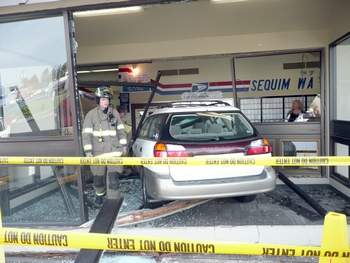
Image: peninsuladailynews.com
Rob: That distinction belongs to the US Postal Service.

Mark: Wow, interesting. Any contacts with them yet?

Rob: Stay tuned.

Editorial Note: Be part of the discussion via the Storefront Safety Council LinkedIn group.

May 29, 2010

Senior Drivers Have High Crash Rates

Wall Street Journal reporter Kelly Greene offers a highly informative piece on driving choices for seniors (When It's Too Expensive For Dad to Keep Driving – May 29, 2010). "People who are 75 and older have higher crash rates per mile than all groups except 16- to 25-year-olds, according to the Insurance Institute for Highway Safety," Greene writes.

While most of us hope to keep driving until we're a ripe old age, acknowledging when we're 'ripe' can be a challenge. Moreover, according to the U.S. Administration on Aging: "By 2030, there will be about 72.1 million older persons, more than twice their number in 2000. People 65+ represented 12.4% of the population in the year 2000 but are expected to grow to be 19% of the population by 2030."

The IIHS crash stats combined with the AoA population growth projections beg the question: As the percentage of seniors in society increases, and if seniors continue to have high crash rates, does the risk of vehicle intrusion crashes into storefronts also increase?

I'd like to identify some storefront crash data sources that would show the demographics of drivers involved in such accidents. Seniors might represent the biggest—or smallest!—number of these drivers. If you know of any specific data sources, please drop me a comment.